Very soon, in about a week or so, National Training Week (NTW) will be upon us once again. I have been known to be quite critical of some of the initiatives from Human Resource Development Corporation (HRDC). However, this is not one of them. Let’s be fair. Call a spade a spade and give credit where credit is due.
So, in this instance, I find the whole premise of NTW as a nation building initiative not only commendable but also logical and strategic. Here is the excerpt from it’s website, https://www.nationaltrainingweek.gov.my/, explaining the rational behind this initiative.
“In a world where change is the only constant, National Training Week (NTW) stands as a beacon of hope, offering free access to quality learning and development opportunities to people from all walks of life. This initiative is more than just a training carnival — it’s a nationwide movement to future-proof careers, bridge skills gaps, and ignite a culture of lifelong learning and skills enhancement. In collaboration …. … NTW is a one-stop hub for upskilling and reskilling. Whether you’re a fresh graduate, a mid-career professional, or an employer looking to elevate your team, NTW opens doors to opportunities that matter. What sets NTW apart is its accessibility. All programmes are offered at no cost, ensuring that no one is left behind in a journey toward a high-income, knowledge-driven economy. From …”
This initiative is only made possible from the pro-bono contribution of trainers and training providers. Now, this is the good news. What is the bad news?
The bad news is how some in the industry abuse and takes advantage of this initiative to upsell. Don’t get me wrong. There is nothing wrong with marketing yourself as a trainer. However, be appropriate about it.
NTW is a platform and opportunity yo contribute. That should the be absolute primary intent. If the intent of your participation is to expose yourself and market yourself through NTW, that in itself is inappropriate and unethical. It goes against the principle and spirit of NTW. The promotion of oneself shouldn’t be the primary reason. It should not even be the secondary or tertiary reason. It shouldn’t even be in the top 10 list of why you participate in NTW.
Some of you might say, that there is no way we can see someone’s intent. Well, I beg to differ. You intent might be invisible but your action and behaviour is not. Personal Mastery 101 dictates that your intent influences your behaviour and your action. So in the instance of NTW, how do see this intent? We can see this by the kind of offerings that is done by trainers throughout NTW.
Upselling is rampant. So is previews. How can these be about upskilling and reskiling with quality learning and development opportunities (which by the way is the essence of NTW)?
There are also courses that ran only for less than an hour and many for just two hours. Yes, I don’t deny that we do learn even if it is one minute long. Yet, ask yourself. Are you truly producing meaningful learning in such time span? Are you doing these “brief learning session” to just fulfil the bare minimum and ticking boxes in hope for future rewards? If the future rewards come, so be it. That is secondary and should never be the primary focus intent.
Kalau nak bagi, bagi betul betul. Jangan ala kadar aje. Hold back some things sebagai umpan for enrolment into another program. Jangan jadikan NTW tapak untuk kau market program kau. NTW is an opportunity to put aside our selfish intents and truly contribute unconditionally. It is only happening once a year and you can’t even pause your self promotion for just this brief moment?
Wahai trainer seMalaya, janganlah complaint. Do something productive and forward moving if you don’t like something. Ini bitching and being victimy in social media. Stop that. Your are hurting your public profile. People are watching, clients will do their research on you by visiting your social media. You don’t want to be scored low because of your public persona is one of whining, bitching and victimy. If they do so, don’t blame anyone. You are responsible and at source.
Wahai trainer yang hebat-hebat, stop accepting rates that you find not favourable to you. What is the point accepting the fee offered and then bitch about it? It was your choice. You choose the rate. You could have easily said NO and walk away. No one is the wiser. Ini dahlah setuju terima secara sukarela (How I know? Because no one puts a gun at your head to accept) lepas tu act macamlah dipaksa terima! Btw, do you know that once you accept the rate, it is already a contract? You have promised to deliver the job with the rate given. What does it say about you as a person that whines on your promise? Dalam trainining baik nor mengajar org growth mindsetlah, responsible attitudelah tapi sendiri tak pakai.
Wahai trainer yang baik hati, if the rate given to you is not your standard, walk away and be ok with it. The job is not meant for someone of your calibre. It is meant for someone else that has less to offer than you. Be ok. Be generous. Be grateful that another trainer who needs that job can how cari makan. Tak payah lah nak conquer semua job yg ada. You are meant to get a better rate some other place and some other time. Have FAITH in your rezeki. Rezeki tak silap alamat lah bro.
Wahai trainer yang bijaksana, your content outline (CO) is not unique, neither it is gold! So what you have your content outline and someone else’s use it? Can the person deliver like you? Does he have the wisdom you bring into the room? Does he have the conviction of example you use? Alah, sedarlah. ChatGPT can craft a much, much better outline than you. So, your content outline is not lah so unique. Pleaselah. Sedarlah what you value is, where your value lies. Your value is not in your CO.
Wahai trainer yang sangat mulia, janganlah buruk sangka yang training provider (TP) ambil your CO and pass it to other trainers to deliver. Macamlah kau sorang aje ada CO. Macamlah trainer yang lain tu takde CO yang similar to yours. Macamlah TP bila nak pitch for a job tak approach other trainers and tak minta CO from them. Macamlah kau punya CO yang terpaling. Tak ke mananya.
Wahai trainer yang serba boleh, sedarlah TP tu bukan musuh kau tapi rakan kongsi kau. They do the job that you are not willing to do – marketing training. If you are so pissed about them, stop using them and do it yourself! Hah! Tak nak pulak. Asyik complaint, complaint, complaint. Buatlah kalau tak setuju apa dia org buat. Go out there, network, do preview, create rapport, seek RFPs, submit proposals etc. Cakap senanglah.
Wahai trainer yang kaya raya, kalau nak lebih fee, investlah. Ini malas atau kedekut nak invest on new learning, techniques, models, certification etc. Dahlah kedekut nak invest tapi bila rates nak tinggi aje. Apa hal aku nak bagi rate tinggi kalau kau sendiri tak nak upskill yourself, dah 10 tahun guna bahan yang sama, tak pernah improve cara engagement, cara present boring, malas nak improve slides pun dan sebagainya.
Wahai trainer yang amat rajin, kalau nak fee yang amat tinggi, ambil alihlah kerja TP. Pergilah direct to clients. Buatlah proposal and RFPs. Take risk of time and effort to nurture and establish great relationship with clients. Ini malas nak buat kerja-kerja ni tapi nak fee tinggi for the least effort. Wah!!! Adilnya kau.
Wahai trainer yang tersohor, bukan semua orang kenal kau walaupun kau dah jadi trainer dah 200 tahun. Tahulah kau rasa kau hebat tapi kalau new client nak test kau, be grateful lah ada org interested in you. Lagi satu, mana Integrity kau? Cakap suruh be open, be humble, be brave tapi sendiri takut and tak open to be assessed. Amboi, dalam training baik nor assess and evaluate people tapi in real life tak nak kena assess and evaluated. Bila kita tak walk the talk, itu namanya not in integrity atau Melayu panggil munafik!!
Wahai trainer yang pandai melangit, your CO tu taklah valuable sangat sampai nak charge segala. Do you realise that your CO is your calling card to open doors for you? Your CO only indicates that you know the topics that needs to be covered, itu aje. Entry point. Kalau kau tak bagi CO pada TP, janganlah harap nak dapat job nanti. Zero CO, zero job. Give CO, higher chance than zero of getting a job. Lagi pun, kalau TP boleh buat CO, why do they need you to do it? Bersyukurlah TP tak tahu buat CO. Work with them, don’t alienate them. Imaginasi if they don’t need you anymore to do CO? What do you think will happen? Each of us have a role to play in our supply chain.
Wahai trainer yang serba tahu, jangan tuduh TP tak berlaku adil. Do you know what it takes to run a training company with staff, overheads etc? Do you really think TP tak aware that if they tak adil with you, they will lose you? On the other hand nak fikir pasal cost of running a company and on the other hand nak take care of the main resource; you. This is not an easy balancing job. Kalau tak percaya, buatlah!
I know I sound harsh yet I am called to be blunt and say what needs to be said.
I am a trainer myself and also a TP. I see both side of the coin. Yes, TP pun tak sempurna. Dia orang pun ada complaints about trainers just like trainers do about TPs. Unfortunately, there are more trainers than TPs. Therefore, what is said my trainers sounds louder. When it is loud, it draws attention. When the noise is about complaints, victimy, dissatisfaction and all things unfavourable, that represents the industry. When the industry is known for that, it produces a negative image. And a negative image brings disrepute. Thus no one respects this nobel industry. That is why I focus on us trainers.
Rather than bitch and whine, why don’t we think on how can we can become a respectable industry? Let’s stop the whining and bitching and Stuart talkin about ideas. Better still, take actions to make this industry better.
I am taking action by writing this reminder to me and to others like me. Let’s build this and not destroy it from within.
One of the privileges (or tragedy, depending on how you feel about it) of being an adult is making decisions and standing by the consequences of the decision. It is a scary thing indeed.
Before this, our parents are there to be make those important decisions and taking responsibility of it consequences. They are also there to pick up any fall out of our decision. They do that out of duty as well as love.
However, as we enter adulthood, that ‘scary’ thing, decision making, now fall square and solely on us. Deciding might be easy however what is scary is the consequences of the decision.
Our decisions not only creates our reality but they also shape us as a human being, and vis versa. Our mental health is also connected very closely with our decisions. Basically, our very existence and how we exist in the world is due to the decisions we make.
On this note, knowing how important decision making is, how come we have never been taught or made aware of how to make great decisions? Unfortunately, the consequences or impact of our decisions are not fully visible to us. We might have an immediate output from the decisions but the impact might come way after. This is what makes it double scary and difficult.
Yet, the above situation still doesn’t solve the issue on how to make great decisions?
The answer lies in the saying “Not only do the right thing but also the things right.” This phrase talks about what is legal and what is ethical. And this what should govern our decisions and actions.
This is the very essence of the term professionalism; doing the right thing and doing it right.
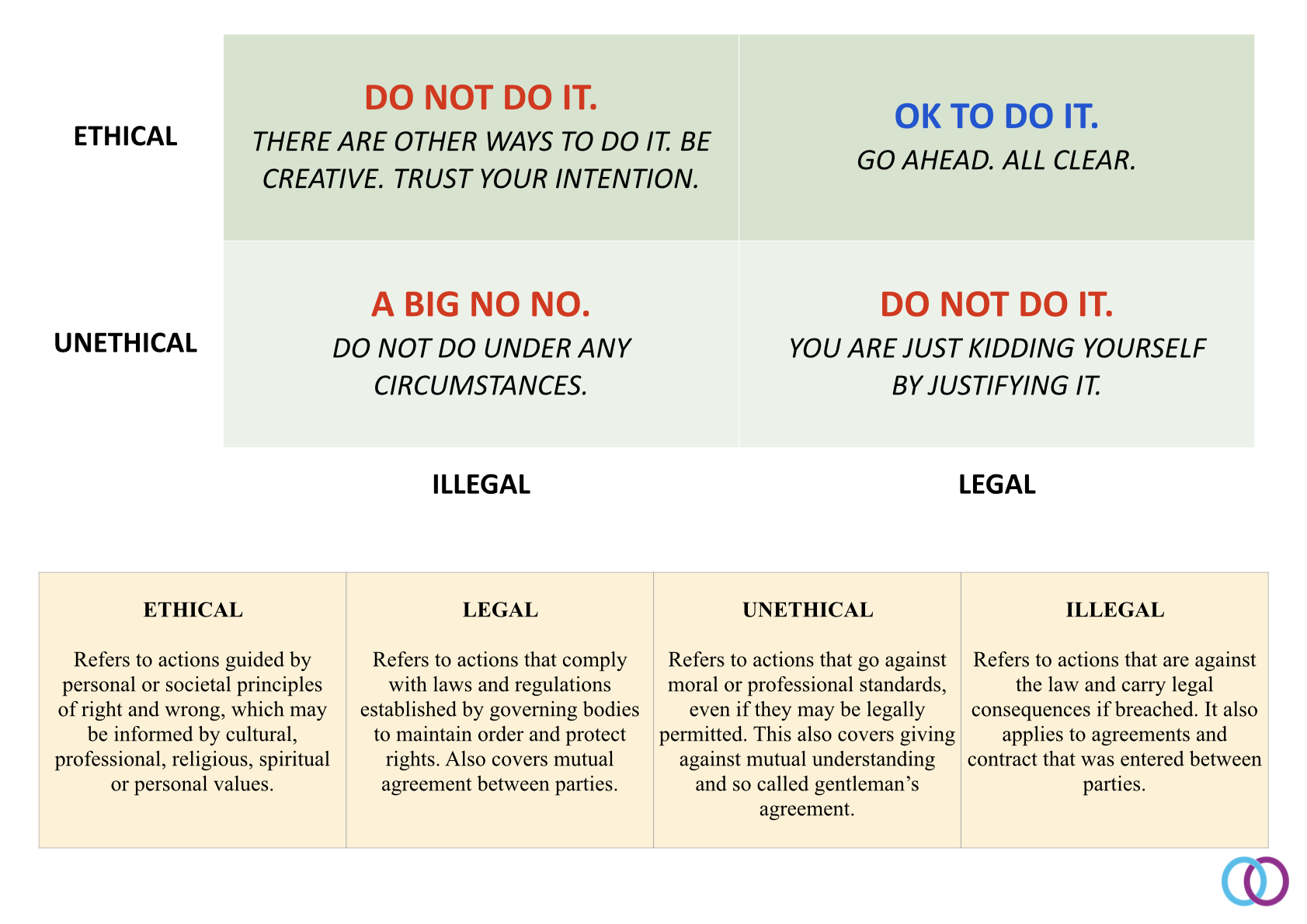
So, what is the difference between these two? I do not like to use the word difference because the word difference has a connotation of two opposite things. Ethical and Legal should be like a joint at the hip. Therefore, rather than the word difference, let’s use the word distinction.
KEY DISTINCTIONS
Ethical: Refers to actions guided by personal or societal principles of right and wrong, which may be informed by cultural, professional, religious, spiritual or personal values. For example:Honesty, fairness, and responsibility often fall under ethical principles in professional settings.
Legal: Refers to actions that comply with laws and regulations established by governing bodies to maintain order and protect rights. For example: Laws that protect employee rights, such as minimum wage and working hours, define the legal boundaries in the workplace.
Unethical: Refers to actions that go against moral or professional standards, even if they may be legally permitted. For example: Lying about work performance may not be illegal but is often seen as unethical.
Illegal: Refers to actions that are against the law and carry legal consequences if breached. For example: Falsifying documents or committing fraud can lead to severe penalties and legal action.
With these distinction, it is clear that a great decision is one the is ethical and legal. What are some examples of these distinctions coming into play at the workplace.
Four Key Scenarios in Decision-Making
Ethical but Not Legal: Sometimes, doing the right thing may technically be against the rules or laws, putting individuals in complex situations.
Scenario: You work for a company that operates strict confidentiality policies on its customer data. One day, you discover that a customer is at risk of significant harm due to the company’s failure to disclose certain information. Even though sharing this information with the customer would protect them, it would violate company policy and possibly data privacy laws.
Explanation: In this case, acting ethically means prioritizing the customer’s well-being, even if it conflicts with company policy or data regulations. It’s a challenging scenario because legal repercussions might follow, but it highlights the importance of ethical responsibility.
Legal but Not Ethical
There are instances where actions comply with the law but may be morally questionable or even harmful.
Scenario: A company offers an unpaid internship that requires long hours and heavy responsibilities, benefiting from the intern’s hard work without compensation. While unpaid internships are legal in certain contexts, the lack of compensation or support can exploit young professionals trying to gain experience.
Explanation: Legally, the company may be within its rights to offer unpaid internships, but ethically, it raises concerns about fairness and valuing people’s time and effort. For a young professional, this scenario underscores the importance of balancing legality with fair treatment and respect.
Unethical and Illegal
Some actions are clearly wrong, both legally and ethically, and carry serious consequences.
Scenario: A young employee notices their manager asking them to alter financial records to present a better quarterly report. This practice is illegal (financial fraud) and unethical, as it involves dishonesty and potential harm to stakeholders.
Explanation: Engaging in both unethical and illegal actions can severely damage one’s career and lead to legal consequences. This scenario reinforces that adhering to both ethical principles and legal standards is crucial in maintaining professional integrity.
Legal and Ethical
Ideally, professionals should aim for actions that align with both ethical principles and legal requirements, contributing to a healthy workplace culture.
Scenario: An employee witnesses a coworker struggling with a task and offers assistance, following company policies and promoting teamwork. This act supports a positive work environment and adheres to professional conduct codes.
Explanation: By acting both legally and ethically, young professionals build trust, foster collaboration, and contribute positively to their workplace. This scenario serves as a reminder of the benefits of aligning personal values with company standards.
With this as a guideline or framework, decision making now seems less daunting. However, it is still not easy. Hopefully, it will be easier now with a framework to guide us.
Two recent events have made me think of branding more intently. And I believe I have made a clear conclusion for myself on the question of “What is a brand?” especially in the context of a Learning and Development (L&D) practitioner.
Let me relate these two events as best as I can.
The first incident didn’t happen to me but to my partner, Yasmin. Recently, we have been busy recruiting trainers, facilitators and training assistants for a a roll out of our financial literacy program for kids. This year has been exceptionally challenging because of the 50% increase in the numbers of schools involved. Previous years have been a blessing because our faculty was enough to support the roll out. We had senior coaches, experienced trainers and well established facilitators coming in to play various roles.
It so happened that this year, the need for more faculty has led us to be exposed to new L&D talents of various background, expertise, competency and experience.
Interesting enough, a few of them are at par to our existing faculty while some are still growing in stature. However, two things that are common in all of them is the desire to learn and contribute to the nation. This requires a deep sense of humbleness and hunger to grow. Two very important characteristic of an L&D practitioner.
What prompted this journey of reflection was an incident where a trainer that initially agreed to participate decided to withdraw because she feels the work that she will be doing will spoil her branding. I am unsure of her branding since I am not familiar with her but what for the life of me, I can’t imagine supporting another trainer to set-up the room, play music, facilitating discussion with the 10–12-year-olds, be a game master, carrying supplies can ever spoil a trainer’s branding.
In fact, I believe, the contrary will happen. There is no shame or beneath someone doing the simple and mundane. In fact, the willingness to support another fellow practitioner is commendable. Personally, I have always enjoyed supporting trainers doing support work because that was how I started. It brings back memories as well as being in a state of full contribution is awesome.
The other event that also coincidently provided me with the same conclusion was my own recent experience of being assessed on my delivery. This is by a new client. At first, when the request for me to deliver a mock training in front of a few assessors was made, I must say I was taken a back. At the same time, I observed that there as a sense of uneasiness with being evaluated. This was an automatic feeling I had. Upon pausing and reflecting, I realised that my ego was the one that was uneasy. Logic and sentiments dictate this request being a more than fair request seeing that I am new to them and that the daily rate I quoted is a five figure one. However, even with these overwhelming factors, I still felt slighted for being called to be assessed. This was how it dawned on me that I have taken without being fully aware and deliberate, the high ground of snootiness!!!
So what, that I have been delivering the last 2 and a half decade? Who cares especially if I am new to someone?
So what, that my rate is way about and more than double that of the standard market rate? To think of it, I need to proof even more that I can truly deliver if my rate is such.
So what, that I have under my belt various certification in a various role in L&D such as facilitation, design, coaching etc. Big deal! All that is in paper. The main thing is, can I demonstrate all that in real life?
So what, that I have a 12 year old L&D consultancy? Can I still deliver or not is still pertinent.
So what, that I train other trainers and that in my life time, so far, I have trained more than 4000 trainers nation and regional wide, certify coaches and facilitators? If so, why be afraid to do a mock training? Seem only fair since I do put my coaches, Trainers-in-training, and facilitators through the same type of assessment.
In a nutshell, rather than being taken a back, I should rejoice that I have an opportunity to be humbled and allowed to learn once again on what is important to me.
So there I was, preparing like a new kid on the block, feeling nervous like a first time trainer at his very first training, practicing like my life depended on it and all along feeling nervous and yet ALIVE!!!!
Yes, I did humble myself to deliver the mock-up training, enjoyed the whole experience, and at the end refreshed me.
I learned a lot doing my After-Action Review (AAR) and made me all that more in gratitude for the chance to sharpen the dullness of my delivery. It is like a reset for me. I am now waiting anxiously on my feedback and the result of the assessment so that I can improve.
After the mock delivery, I was interviewed by four of the organization’s inner assessors in various topics such as methodology, learning impact, design considerations etc. I was grilled with tough relevant insightful questions. I thoroughly enjoyed the viva.
Through that encounter, I realised that branding is nothing more and nothing less but my character. My character is my branding, and this can be as obvious as a logo because our character is manifested in our behaviours and what we communicate. The set of actions we take and the way we articulate our thoughts are all windows to our character. And these brands us.
Therefore, how we act and how we speak is already our brand. Our response to situations and our speech surrounding those situations is a clear message of who we are; OUR BRAND.
To those that feels menial work as a training assistant unworthy of you because others do it for you, please think twice. The fear that your branding will be tarnished by menial works, has just came through, a self-fulfilling prophecy. There is nothing to lose in being humble. It is in fact a potent branding to have.
In designing a learning session, we often come across words like Objective, Outcome, Output and even Impact. Often, new trainers designing an RFP (Request for Proposal) will need to articulate these terms well and do get confused. Well, even seasoned trainers too get mixed up with these terms. What more new trainers. It is understandable this happens because even in the RFPs, they sometimes get it wrong.
This phenomenon was brought up recently by one of my mentees. I have about 9 trainers in my current apprenticeship program. Two of them came for a one-day workshop and in the workshop these terms were brought up by another participant. While a few understood it, quite a few expressed their desire to know the distinction of these terms. I knew this was important to address because this issue falls smack in what we call Distinction Work. My late mentor always mentions that the two important area of study that a trainer should be good at if they want to be a great trainer is distinction work and context work.
So, let’s unpack this issue by first being acquainted with the meaning of each term.
Objective: a thing aimed at or sought; a goal.
Output: the amount of something produced by a person, machine, or industry.
Outcome: the way a thing turns out; a consequence.
Impact: a marked effect or influence.
Now, we need a model to tie all these terms together. To this end, let’s use the Theory of Change as the model.
What is the Theory of Change (ToC) is the logical follow-up question to be asked. So, Theory of Change is …
… essentially a comprehensive description and illustration of how and why a desired change is expected to happen in a particular context. It is focused on mapping out or “filling in” what has been described as the “missing middle” between what a program or change initiative does (its activities or interventions) and how these lead to desired goals being achieved. It does this by first identifying the desired long-term goals and then works back from these to identify all the conditions that must be in place (and how these related to one another causally) for the goals to occur.
These are all mapped out, usually in a diagrammatic template. The template then provides the basis for identifying what type of activity or intervention will lead to the outcomes identified as preconditions for achieving the long-term goal. Through this approach, the precise link between activities and the achievement of the long-term goals are more fully understood. This leads to better planning, in that activities are linked to a detailed understanding of how change happens. It also leads to better evaluation, as it is possible to measure progress towards the achievement of longer-term goals that goes beyond the identification of program outputs.
(Source: Centre for Theory of Change)
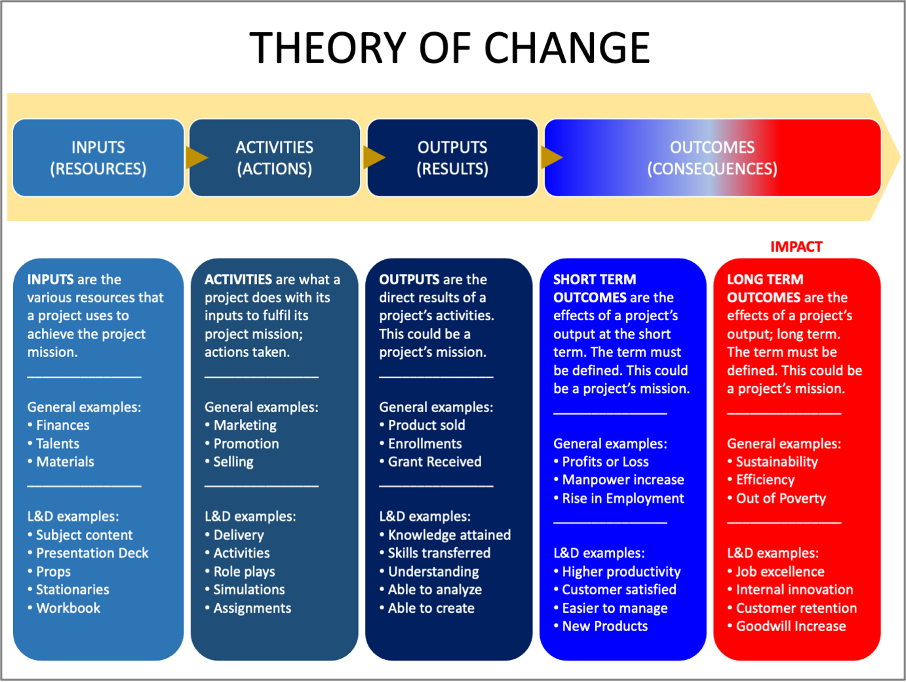
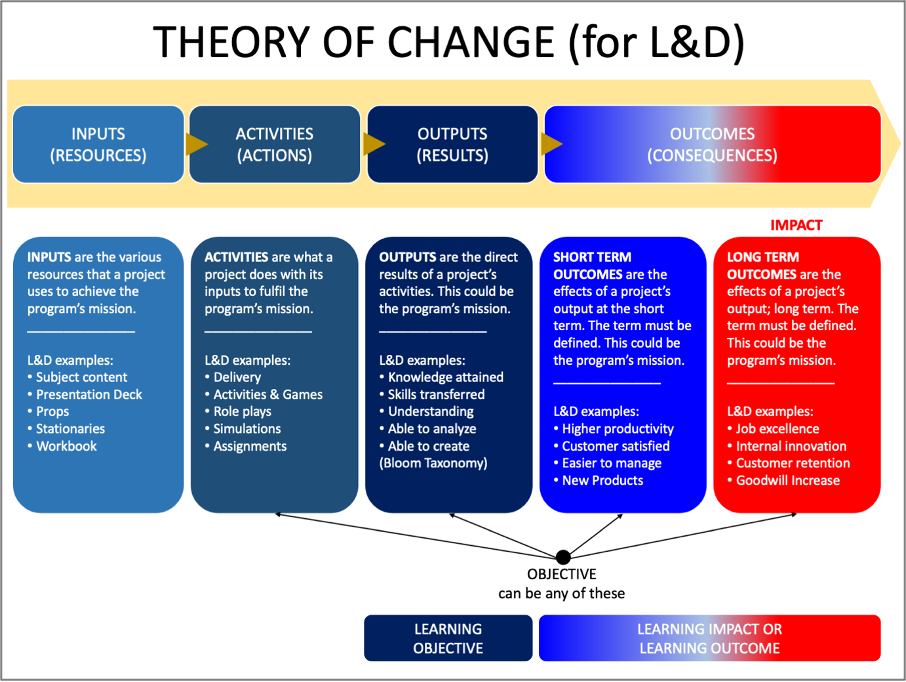
In terms of a visual, below is a diagram explaining the ToC.
This diagram clearly shows the relationship between Output and Outcomes. What about Impact? In terms of impact, there are a few schools of thought on it.
The first school of thought equates Outcomes to Impact. Basically, it is one and the same. When someone says refers to Impact, that person essentially is referring to the Outcomes of the program or project.
The second school of thought says that Impact is after Outcome. This school of thought pushes the Impact even further into the future. In essence, the Outcomes produces Impacts way into the future, and it is a significant effect of the Outcomes.
The third school of thought (which I subscribe to) splits the Outcomes into Short Term and Long Term. The Impact is basically the Long-Term Outcome. It is described as the ultimate outcome of the program or project.
Here is the diagram with the Outcomes being split into two thus showing the relationship between impact, Outcome and Output.
Regardless of which ever school you subscribe to, clearly Impact is after Outputs. Therefore, when referring to Impact, it is important for us to spell out our ToC so the others are aware what we are defining.
Now that we have address the topic of Impact, let’s now look at Objective.
Based on the definition of Objective, we can than conclude that an Objective can be either Activity, Output, Outcome, or Impact. Objective is basically what we want to achieve. In a project, the objective might be generating activities. It can even be certain results that we would like to achieve out of the activity. It can even be the short-term effect or even the long-term consequences of our actions.
However, in L&D, the Learning Objective refers to the Output of the learning session. What do the learners immediately get at the end of the learning session. The Learning Outcome will then refer to who will they become or what can they achieve after the Learning Objective (which is the session output) is met. This can be referred to as the Learning Impact.
Below is a diagram that summarizes these points.
Gone are the days when what is delivered and measured is the Activity and the Results. Increasingly, more and more L&D managers are concern with Learning Impact. This puts a new demand on trainers to evolve from just a deliverer of content to a designer of development. The development part of L&D now becomes even more pronounced. To this end, a trainer will need to embrace and incorporate other developmental skills such as facilitation and coaching, not to mention learning session design. Trainers need to now evolve to L&D consultants. The effectiveness of a consultant will to be based on the measurement of their impact.
Using the ToC, it becomes clearer what we need to measure as a trainer.
Recently, there have been a lot of chatter about content outline in the local learning & development (L&D) social media. This is nothing new. This topic is like the recession; it comes back once every so often. It never dies, just like the issue of trainer’s rates, unfair treatment of or by training providers, HRDC not taking care of trainers etc.
As usual, I have my own point of view on this, and it is derived from the little experience I have being involved in the local L&D scene as well as my social work around building community of practice in one form or the other. One other potential benefit that I might have is the fact that I have been fortunate to be playing or has played various roles in L&D from being a trainer, to a training provider, to a consultant etc.
Let’s weigh in on this topic by first recognizing what is a content online?
Even though, there are numerous definitions of what a content outline is, however each one of them do have one distinction in common which is “a general description about the content; it is not detailed.” Therefore, we can equate a content outline as a picture of a dish. This means, it is not the dish itself. It has not been cooked but a visual representation of a finished dish.
If the picture of a dish can never be the dish itself, therefore a training content outline is not the training itself. And here lies the value of the content outline – almost nothing. As much as a picture is not the dish so is the content outline is not the training.
Now, let’s take this analogy further. Do you pay for the picture, or do you pay for the dish? Of course, the dish. Now, do you pay the photographer of the picture of the dish, or do you pay the chef that cooked the dish? Ofd course the chef. This means, a client doesn’t pay for the content outline, they pay for the training, the skill of the chef, the ingredients in the dish etc. This diminishes even further the value of the content outline.
Now, can a content outline be of use? Of course. Just like a photo of a dish can be useful. Yet, the fact still stands that the picture is not the dish.
The picture can entice the diner, give an expectation of how the dish looks like, and provide a benchmark of the dish. However, it is still unable to give an indication of the taste, the freshness of the ingredients, how it is truly cooked and served. Just like a training outline provides indicators of what a training will look like, what it entails etc yet the content outline is still unable to represent how the training will be conducted, is learning really going to happen, the value of the experience and usefulness of the training to the learners.
The faster trainers realise the value and use of the content outline, the more assured the trainers will be in marketing themselves.
So, what is the real use of the content outline to a trainer? Well, the content outline is the means of increasing the potential of getting a job. That is it.
Think about it. If, the trainer profile is what truly sells the trainer, why bother to provide the content outline? Why do clients want the content outline? Think of your client as a diner that would like to see a picture of the dish to provide some sort of insight whether to order or not.
Also think about this. If a training provider can do their own training content outline, why do they need to ask it from the trainer? Won’t it be easier and cheaper if they can do it themselves? Well, the simple answer why they ask from the trainer is because they can’t do it themselves. They are not a trainer. They are a training provider. This situation is good news for trainers because the training providers are relying heavily on us for content outlines. So, help them to help us.
These two thoughts will lead us to the inevitable conclusion that the content outline is what will open doors for the trainer… through the training provider.
This also means that if a trainer is reluctant to give their training content outline, therefore, the chances of work will be less because the training provider can’t submit anything on our behalf. However, if the trainer provides their content outline to training providers, then the training provider will be able to submit more jobs and the probability of the trainer getting a job is so much higher. It is not a guarantee, but the probability is definitely higher than not giving out their content outline. It is a numbers game pure and simple.
Let us now address this so-called problem of training providers taking a trainer’s content outline and once they get the job, they pass it to someone else to do it. Usually to a trainer who is much cheaper. Many trainers cry foul over this. I can understand where they are coming from. Trainers feel their effort is not recognised. For this reason, my heart goes to them. But if the reason is about intellectual property (one of its kind… my training is special. I am special. No one do what I do), it is illegal, or my ego is slighted because I am a great trainer and I feel used etc, I have a few wake-up calls for you.
Number one. It is not illegal. Is it unethical? I would say yes but it is not illegal. So, live with it. It is part of the game.
Number two. Training provider is using me. Well, when we don’t get it, we say that. But when we get it what do we say? We say nothing right? The simple truth is that we are also using them to get us jobs. Grow up for goodness sake. Be fair. It is a win win. You need them as much as they need you.
Number three. My content outline is unique, special, and one of a kind. It is my intellectual property. Let me ask you this. If it is so special and unique how come the training provider is confident enough to give it to someone else to deliver? I am sure the training provider will not give it to some other trainer to deliver and risk the job being a shambles if he truly finds it unique and special and that you are the only one that can do it. The reality is that, based on result, it is not special and unique. The training provider is experienced enough in seeing so many training content outline, even more than you, to know if it is unique to not give it to someone else. Please get off your high horse. Anyway, if you don’t get the job, just be ok that the job is not meant for you. Learn from it and move on. You can even treat this as a filter. If you encounter any training provider that does that, great news. One more training provider you don’t have to bother to work with. Isn’t that great, reducing the numbers.
Number four. As long you decide to play this game as a freelance trainer and to rely on training providers to market you, live with the rules of the game. Please don’t bitch and whine. It is part of the game that you have chosen. Stop being a victim. If you feel strongly about it, be a training provider too and market yourself so that you can do your own content outline, you can then submit your own content outline, you will then get the job yourself, you can then hire yourself and you don’t have to give it to others. Along the way, be ok to pay for marketing cost, administration cost, other operating cost etc. If you are not willing to pay the price, don’t buy the dish. If you can’t stand the heat, don’t be a chef. Pure and simple. The choice is in your hands. You know very well the consequences.
As for me, I do not put stock to the photo of a dish. The proof is in the dish itself. Just like my mum’s asam pedas.
My mum’s asam pedas is not good looking. It is full of daun kesum (Chinese Knotweed) – all over the gravy with the stalk still attached, chili oil floating, dark red gravy with chili seeds floating, daun kantan (Torch Ginger Flower) cut haphazardly, there is cabbage in it, brinjal, sayur asin, iununiformed fish sizes etc. My word, a total havoc. It is nothing like the pictures of asam pedas in hotel coffee houses, with carved tomato decoration, chili cut into shape of flowers, clean sidewall etc. Guess which one is the best I have tasted?
The Importance of Ethics in the Training Industry (or any industry for that matter)
Ethics is defined as moral principles that govern a person’s behavior or the conduct of an activity. It is above and beyond legality. It is a relationship that is taken for granted both ways; one equates both as twins that can’t exist separately, while others take for granted that they are two different mutually exclusive parts. The latter state is a convenient way of justifying actions, especially unsavoury ones; they are legal but unethical. They are even those that are oblivious to the existence of ethics.
If I were to simplify the relationship between law and ethics, I would use the analogy of rice. White rice is what legal is: basic, standard, applicable to all. It is the bare minimum of what a rice should be. Ethics is the condiment that makes the basic white rice wonderful. Turning it into nasi goreng, nasi lemak, nasi lemuni, nasi ayam etc.
As human being full of fallible, we need law and order to make things legal; have a set of standards and principle governing us. For good or bad, it is a necessity. Religion is a form of law too; in my opinion, for its functions and purpose is the same. Imagine a world without law and order. It will be chaos and we won’t be able to live our fullest life and potential.
Now, if there is already law that make things legal, why do we need ethics?
As human being, we do not just exist. Each one of us thrive to be a better version of ourselves. Inert in each of us is the desire to move up Maslow’s Hierarchy of Needs. Here is where ethics come into play. Ethics allows us to not just survive (lower needs) but to thrive (upper needs). It self-actualizes us; it allows us to self-govern ourselves, it brings in empathy, consideration into our daily life.
It makes our life alive; just like the condiments makes the white rice exciting.
In the training industry (as in all industry, I presume) there are many examples of unethical practices that gives a bad undertone to the industry. Let me give an example.
When you are employed in a training company, you will manage clients on behalf of the company. This is part of your work. The client gave the job because of the company. You are paid to fulfil the commitment contracted between the company and the client. In this case, the client is not yours. It is the company’s.
Now, when you are no more employed by the company and the client not knowing any better contacts you to do the same job as before, you have two choices.
The first choice is to inform the client you are no more employed with the company. You and the client than refer to the company on this new job. It is up to the company to then decide what to do. This is ethical.
The second choice is to take the job and do it yourself. In this case it is legal yet not ethical.
In the second case, it leaves a negative undercurrent because the company that employed you have the first right of refusal over you.
You might ask, why does the company have the first right of refusal?
The company have spent effort in obtaining the client. The company has a track record. The company has invested in reputation capital such that their goodwill is known. The company is capable. These are why the company got the job in the first place. All this effort is not your effort and must be respected.
If ethics were applied here, there is a huge possibility that a win win can be achieved. Yet, because the stand taken was more legal than ethical, a negative undertone exists.
Who needs law if there is ethics? -The Importance of Ethics in the Training Industry (or any industry for that matter)
Ethics is defined as moral principles that govern a person’s behavior or the conduct of an activity. It is above and beyond legality. It is a relationship that is taken for granted both ways; one equates both as twins that can’t exist separately, while others take for granted that they are two different mutually exclusive parts. The latter state is a convenient way of justifying actions, especially unsavoury ones; they are legal but unethical. They are even those that are oblivious to the existence of ethics.
If I were to simplify the relationship between law and ethics, I would use the analogy of rice. White rice is what legal is: basic, standard, applicable to all. It is the bare minimum of what a rice should be. Ethics is the condiment that makes the basic white rice wonderful. Turning it into nasi goreng, nasi lemak, nasi lemuni, nasi ayam etc.
As human being full of fallible, we need law and order to make things legal; have a set of standards and principle governing us. For good or bad, it is a necessity. Religion is a form of law too; in my opinion, for its functions and purpose is the same. Imagine a world without law and order. It will be chaos and we won’t be able to live our fullest life and potential.
Now, if there is already law that make things legal, why do we need ethics?
As human being, we do not just exist. Each one of us thrive to be a better version of ourselves. Inert in each of us is the desire to move up Maslow’s Hierarchy of Needs. Here is where ethics come into play. Ethics allows us to not just survive (lower needs) but to thrive (upper needs). It self-actualizes us; it allows us to self-govern ourselves, it brings in empathy, consideration into our daily life.
It makes our life alive; just like the condiments makes the white rice exciting.
In the training industry (as in all industry, I presume) there are many examples of unethical practices that gives a bad undertone to the industry. Let me give an example.
When you are employed in a training company, you will manage clients on behalf of the company. This is part of your work. The client gave the job because of the company. You are paid to fulfil the commitment contracted between the company and the client. In this case, the client is not yours. It is the company’s.
Now, when you are no more employed by the company and the client not knowing any better contacts you to do the same job as before, you have two choices.
The first choice is to inform the client you are no more employed with the company. You and the client than refer to the company on this new job. It is up to the company to then decide what to do. This is ethical.
The second choice is to take the job and do it yourself. In this case it is legal yet not ethical.
In the second case, it leaves a negative undercurrent because the company that employed you have the first right of refusal over you.
You might ask, why does the company have the first right of refusal?
The company have spent effort in obtaining the client. The company has a track record. The company has invested in reputation capital such that their goodwill is known. The company is capable. These are why the company got the job in the first place. All this effort is not your effort and must be respected.
If ethics were applied here, there is a huge possibility that a win win can be achieved. Yet, because the stand taken was more legal than ethical, a negative undertone exists.
As human beings, we are wired for better things. It is one of the traits that keep us at the top of the food chain, good and bad news. It is innate for us to solve problems. We as human beings are quick at wanting to remedy any unpleasant situation that we tangibly experience. We do this even if it happens to someone else. A case in point, how many times have our friends offered a remedy for a complaint at the midpoint of our sharing before even fully listening and digesting what we said?
When problem solving, we take a focus perspective, somewhat of a tunnel vision. Of course, this is needed. It is in fact a pre-requisite to solving problem. That is why it is easy and quick for us to offer a solution.
The same is true when we are complaining about something. That is why it is very easy to complaint because the problem is clear to us. Why is it clear? It is because when something unpleasant happens, we see the specifics of the problem. We can articulate the problem very well indeed. This is what I call a MICRO perspective.
A micro perspective makes the details clear. That is why complaints are colourful and clear. And that is also why solutions can be found. As listeners, we get hooked on the details of it so much so that a solution for the complaint is easy to come by.
However wonderful micro perspective is, there is a huge flaw in it as a solution provider. A micro perspective doesn’t provide context and wider understanding of the eco-system of the problem. A problem is never in isolation to what is going on it its space. This understanding requires another perspective, which is what I call MACRO perspective.
A macro perspective makes you step away from the problem so that you have a wider view of it. This allows you to see other problems related to the initial problem, it reveals relationship the problem has with other elements, it shows you the relationships that exist between elements in the problem eco-system etc. Such an invaluable view in understanding the context of the problem.
The macro view provides such a wealth of information for us to understand and have wisdom in solving the problem.
Now back to complaints that naturally is derived from micro perspective.
How do we then turn complaints and grouses into gratitude?
The answer is in the above discussion of problem solving.
For us to turn grouses into gratitude, it is important for us to move our perspective from micro to macro. This additional perspective will provide us with the whole picture; the overview and the details.
The change of perspective inadvertently will calm us down (since in complaining, we are in a state of agitation) and provide us with time and information to analyse our grouses and put them into perspective.
Usually, as we see the whole picture, gratitude will start sinking in. This doesn’t mean there isn’t a problem or the initial problem that produces the grouse or complaint goes away. With this newfound wisdom because of the micro and macro perspective, we become more rational, calm, and empathetic. This will bring about some gratitude for there is always something to be thankful for even in the direst of circumstance provided we have faith that they exist and trust that we will find them.
In conclusion, what separates grouses and gratitude is just backing a few steps to have an additional perspective. Ultimately, it is just a shift of perspective.
Coretan hamba atas apa yang sedang berlaku kala ini:
Banyak yang kita boleh pelajari daripada alam. BIla saja hamba terfikirkan hal ini, tidak boleh tidak hamba teringatkan buku kumpulan cerita pendek SN Baha Zain; Berguru Pada Binatang yang penuh dengan contoh kayanya pembelajaran yang kita boleh perolehi daripada sikap haiwan. Mari kita lihat gajah sebagai contoh sikap mulia.
Gajah tiada musuh semulajadi dikalangan haiwan. Gajah mempunyai monopoli dan duduk di atas rantaian makanan. Dia boleh pergi ke mana sahaja, buat keputusan apa saja dan buat apa sahaja yang dia mahu. Begituberkuasanya gajah dalam hutan.
Walaupun dengan kelebihan yang sebegini, gajah tidak bersikap angkuh dan sombong. Gajah tidak membuli haiwan lain. Sebaliknya, gajah dikenali sebagai haiwan yang damai, pendiam dan lemah lembut (kecuali bila mengamok). Walaupun sikap mulia ini dikenali ramai, tetapi posisi raja hutan tidak dipegang oleh gajah tetapi oleh singa. Gajah tidak pedulikan semua itu.
Sikap gajah yang menjadi tauladan ini dapat dilihat dalam cerita2 rakyat yang mana selalu meletakkan gajah sebagai contoh mulia.
Jadi, kita harus belajar daripada sikap gajah. Walaupun berkuasa, mempunyai monopoli dan berada dikedudukan paling atas pada rantaian makanan, kita tidak perlu sombong, bongkak, buat keputusan tanpa mengambil peduli kesannya pada orang lain, kejam dan sebagainya.
Yang moleknya, lebih tinggi kedudukan kita, lebih lembut pendekatan kita, lebih inklusif, lebih peka, lebih merendah diri, bukan kerana kita terpaksa tapi kerana kita boleh memilih untuk menjadi yang terbaik untuk semua orang kerana kita berkuasa dan bukan menindas.
Over the weekend, I had the privilege, once again, to assess our 11th batch of Certified Virtual Learning Facilitator (CVLF) program. I have always enjoyed even looking forward to such events because of the richness in learning that I can obtain from being there. How wonderful to spend 2 days experiencing various design aspects about various topics from the various trainer. Community support and camaraderie are also experiences that I value.
As in any session of its kind, there will always be a highlight takeaway and this weekend is no exception. The insight that came up was concerning the conundrum of delivering content and delivering learning. Let me put some context to this insight.
We have numerous Train-The-Trainer (TTT) programs in our stable such as the Certified Facilitative Trainer (CFT) program, Certified Accelerated Learning Facilitator (CALF) program and Game-Based Learning Practitioner Certification (GBL). Contextually, CVLF embodies our TTT philosophy. Within this philosophy, there are numerous concepts that we adopt. One of the concepts that all our TTT like programs have in common is the concept that in any L&D initiative, especially workshops and training, there are three domains that are dynamically interacting with one another. These three domains are Delivery, Design & Engagement (DDE). All these three domains need to support each other in order for learning to happen effectively.
Among the three domains, we have always believed that design is the glue that binds the others. We have always advocated this point of view such that all our TTT like programs has a huge design element in the content. It is our belief that through a well-thought design, the delivery and engagement will be synced to produce the best learning. Here is where we differ slightly with the notion of a trainer being a subject matter expert (SME). To us, it is not enough for a trainer to be a subject matter expert. The trainer must also be a learning designer.
On this note, there is a clear danger of delivering the content and not delivering the learning. What do I mean by this? Some of you might be saying to yourself “What is Juara smoking? Is he confused? Isn’t the two the same?”. Well, I am not a smoker, I am not confused and the two are not the same.
Delivering the content means curating what topics or subjects will be delivered and how to deliver them. Delivering learning goes beyond just curating the content and the delivery of the content but also curating the method of learning the content for the learner. Sometimes, we don’t need to deliver the content and the learning still happens, deeply. This happens when we are focused on delivering learning and not content.
When we are focused on delivering content, we are on a tight schedule to complete the content at hand. We compromise checking in on how the learners are doing, don’t entertain redesigning the content or flow to cater for those that are lagging, don’t include opportunities for reflective practices and we even disregard community learning and opportunities to retrieve tacit knowledge. We also don’t spend time allowing the learning to stew or even remotely interested in the learner’s point of view, thought and feelings. All these elements are critical to learning.
However, if we are truly interested in learning to happen, we will operate differently; we will design differently, we will curate differently and we will deliver differently. We start looking at our learners and how they are doing before, during and after the session with us. We start by understanding where they come from, and what makes them want to learn or not want to learn. We focus on their progress over the period of the workshop and constantly check on their learning well-being throughout the workshop. We will build in pauses and check in to gauge our learner’s learning. We will create opportunities for all voices to be heard. These are but some learning strategies that can be deployed if we are interested in delivering learning.
Another phrase that is associated with delivering learning is learner-centric while the phrase is associated with delivering content as trainer centric. For both, it is more of a mindset that determines our focus and the actions we take.
As we prepare ourselves for any training or workshop, it is worth being conscious of which mindset are we embodying; as a deliverer of content or a deliverer of learning?






 akar setempat, akal sejagat