In The Case of Making A Choice

Imagine this scenario. In front of you, there are two items A and B. You are told to make a choice. How many choices are there in front of you?

The most common immediate response I’ve heard all these years are two, A or B. Upon some thoughts, most will come back with three; A or B or both. This is followed immediately by four choices; A or B or both or neither.

What is interesting is not the fact that the choices increase over time. What is interesting is the immediate response. What can we learn from this? Well, for one, this is an indication how our mind is lazy. It usually only chooses the obvious because it is the safest of choices; there is no risk in the obvious, the common, the predictable and the mundane. The mind doesn’t have to pause and think. That is way too time-consuming and might produce an uncommon situation that might put us in danger. This goes against what our mind is designed to do; to keep us safe. The other choices are not part of the protocol the mind is built with. This is also the protocol that has made us believe we are not creative (outside the norm), need to conform and follow the true and tested.

The other interesting perspective about choice is the fact that we choose based on two very distinct protocol.

The first protocol is what I call Situational Focus. This protocol makes us choose based on what I don’t want to happen to me or what will I lose if I choose. This is the most common protocol we use because it evaluates the risk and increases the safety quotient. This protocol is the most obvious, ‘predicts’ risk to increase safety & security and doesn’t expose the human to the unknown. The mind is unwilling to pay the unknown prices that might come. It is for all this that the mind loves it and makes it the default protocol.  The downside to this protocol is that the choices made have an aftertaste of compromising or making do. It is safe and generates rather low energy. Often, this protocol produces a victim mindset (victim point-of-view) because the human feels it is not the choice that he or she really wants but rather a compromise.

The second protocol is not as common as the first protocol and I call this Future Focus. This protocol makes us choose based on what you desire or what you can gain rather than what you might lose. It is indeed an opposite protocol from the first one. It allows the human to take a risk and to be responsible for overcoming unseen challenges that might come. This protocol has taken into consideration that risk will be there and will be overcome. The protocol generates high energy and a lot of uncertainty, therefore, it also generates fear and excitement too; excited of the what the unknown will throw in. Within this protocol, the human has decided to take responsibility.

The first protocol looks at the external factors while the second protocol looks at the internal factors. These two factors are also choices the mind makes.

There is also the question of choice (pilihan) and choosing (memilih) – making a choice.

The question is do we choose first than be a victim or because we are already a victim that is why we choose what will emphasize our victim-ness.

People become a victim of the challenges they face.

In regards to regret, we only regret something based on what we know now and not what we know then. This is because, if I know the now back then, I would choose differently.


Contribution in Receiving (inspired by Mariam El Bacha)

Reaction: “OMG. I am so inspired. Thank you so much for that. You have really made a difference!”

Respond A: “Ah no worries. Small matter” or

Respond B: “No. No. No I didn’t do much.” or

Respond C: “That thing? It’s ok. It is something I do so often; almost effortless.”

Have you ever experienced something like the above or something similar in context? What really motive us to respond in such a way? Humbleness? Uneasy with compliments or the limelight? Awkwardness? Shyness?

Regardless, these responses might seem harmless and in our mind could even be warranted. However, every respond there is a message that we might be unaware of.

Maybe within our intention to be humble inevitably we have denied two things thus making us somewhat a taker as oppose to a giver. From someone, that is in gratitude to someone is ungrateful.

The first act of denying that we inevitably done is to take away the inalienable right of someone to appreciate someone else; at worst or at best, reduced the magnitude and importance of act itself. It is as if what the giver feels is misleading, less important or even outright wrong!

The second act of denying that we inevitably done is to deny the self all the effort, time, learning that we have gone true to reach to a place where what we do is of significance to others.

One might argue that it is of no consequence because what we did was so simple, so easy, so often done (spelled mastery) and not worth much. Maybe to you but transparent to the giver of praise! In fact in this thought we are showing arrogance by not honoring the work, attention and teaching of those that were involved in us achieving our mastery.

Therefore, in allowing us to receive praise from others for our mastery (whatever it is) is actually an act of contribution to the person that is praising and also an honor on behalf of all the teachers, mentors, gurus, and sifus that have been in contribution to who were are at the moment of the praise.

Be in gratitude for the praise of your mastery for it is not for you but for others!

ps: Thank you Mariam El Bacha for reminding me of such an important life context.

Comfort – Groan – Growth

Some people leave their comfort zone into their growth zone. Between this two is a zone called the groan zone. Here is where all the nasty demotivators; doubt, uncertainty, frustration lives. Once we take a step into the groan zone, we start going into our growth zone in and out, in and out until our groan zone and our growth zone becomes one with our comfort zone thus making our comfort zone bigger. And the magic process of growth starts again smile emoticon.

Note to self (courtesy of Sharmini Hensen)

It takes us to be on the outside to truly appreciate what is in the inside. Just like a goldfish being in a fish bowl; the water is transparent to him until he is taken out of the water.

This ties in closely to the context of empathy; being able to be an observer that truly appreciates and understand what it is like to in one the space of another. What is so powerful about empathy is that it is a peer-to-peer relationship, unlike sympathy which has an element of top-down. This allows discourse and objectivity without compromising one’s own stand.

The connection between the value of an ego with our ability to make choices

Often times it is hard for us to make choices. Based on my own experience, the reason why this happens is because the price for me to pay in making the choice is too big. This can be reduced by focusing on the gains that I might get from making the choice instead of focusing on the price. In addition, willingness to live with the prices is also vital in making a choice.

Having said all this and realising it, I still find it hard to make a choice. During these times, what I observe is that the price is too big and overshadows the gains; well, that is what I thought.

Out of many prices to pay, the hardest to pay is the price of one’s ego. The desire to be bigger, the need of wanting to be better, the desperation to be right , the pull to being richer etc get in the way; big time.

What has worked for me is to hack onto this by reducing the value of my ego.

If I price my ego at RM1million, than of course there will be very seldom a time I will be willing to pay that price. However, what if I price my ego at only RM1? Surely there will be more times I am willing to pay the price.

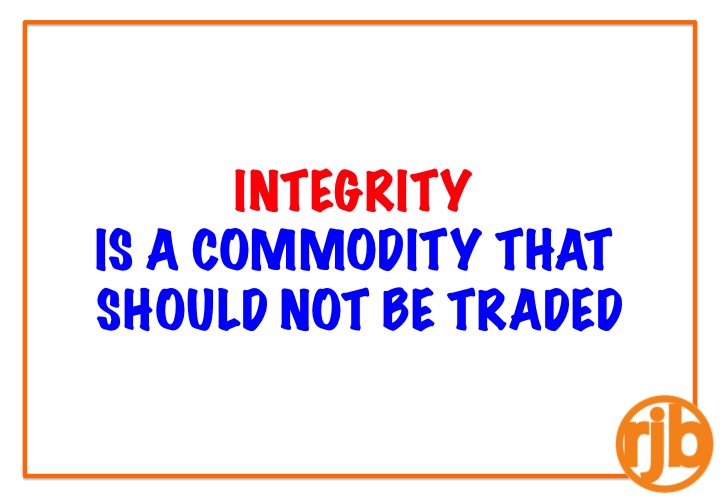
Sad that the value of happiness is less than the value of our ego. So too is the value of trust and integrity.

The sooner we put a realistic value to our ego, the faster it will be for us to gain all that is more valuable to us all.

Coaching 101: The Passenger-Driver relationship of Emotion and Rational

elephant-rider

“Are you willing?” is a question I always ask in coaching. If the answer is YES, than there is work to be done. If the answer is NO, than no amount of coaching and strategising will help. Move on to what is next.

The emotional part is ‘The Elephant’ in Chip & Dan Heath book Switch. Change will only happen when the elephant decides to move.

The notion that emotions has no role to plan in decision making is a myth. It has to do a lot with the decision that you make; in fact a huge part. And get this, it is not the whole part 🙂

A decision that is made with the absence of emotion will be one that is, at best, devoid of energy, motivation and push. While at its worst is a decision void of compassion, humility and humanity. Bare in mind having, recognising and acknowledging your emotion is very different than being emotional. Being emotional is acting at the spur of the moment with the emotion driving the action full force without a passenger-driver called rational.

A healthy balance of both rational and emotion is needed. Both needs to be taken into consideration. One is flawed without the other.

Having said all that, at the end, the emotional part of the decision is what will determine its success. Once a decision is made; either via the rational or emotional argument, the emotion will need to take the lead to drive it with the rational at the front passenger seat. As time goes by, rational will need to trade place with emotion and vis versa throughout the journey till you reach your destination.

Truth Behind Cliches (III)

“The proof of the pudding is in the eating”.

If one is in integrity, one will have the courage to face scrutiny. If one fear scrutiny, one has lost all form of credibility. Honesty and openness is key in this most meaningful of endeavours. Therefore, embrace dialogue, discussion or engagement of any form to create clarity.

Truth Behind Cliches (II)

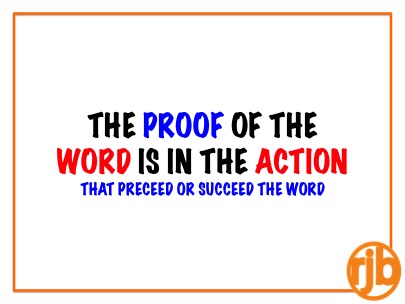
Word, Action & Proof “Actions speak louder than words”. It is not what people say that matters. It is the action that they take preceding or succeeding to the words that truly give meaning to the word. Therefore, be extra careful of hearsay, gossip, news, information or rumours that has no form of tangible, measurable and visible action to it. The proof of the word is in the action.