One of the privileges (or tragedy, depending on how you feel about it) of being an adult is making decisions and standing by the consequences of the decision. It is a scary thing indeed.
Before this, our parents are there to be make those important decisions and taking responsibility of it consequences. They are also there to pick up any fall out of our decision. They do that out of duty as well as love.
However, as we enter adulthood, that ‘scary’ thing, decision making, now fall square and solely on us. Deciding might be easy however what is scary is the consequences of the decision.
Our decisions not only creates our reality but they also shape us as a human being, and vis versa. Our mental health is also connected very closely with our decisions. Basically, our very existence and how we exist in the world is due to the decisions we make.
On this note, knowing how important decision making is, how come we have never been taught or made aware of how to make great decisions? Unfortunately, the consequences or impact of our decisions are not fully visible to us. We might have an immediate output from the decisions but the impact might come way after. This is what makes it double scary and difficult.
Yet, the above situation still doesn’t solve the issue on how to make great decisions?
The answer lies in the saying “Not only do the right thing but also the things right.” This phrase talks about what is legal and what is ethical. And this what should govern our decisions and actions.
This is the very essence of the term professionalism; doing the right thing and doing it right.
So, what is the difference between these two? I do not like to use the word difference because the word difference has a connotation of two opposite things. Ethical and Legal should be like a joint at the hip. Therefore, rather than the word difference, let’s use the word distinction.
KEY DISTINCTIONS
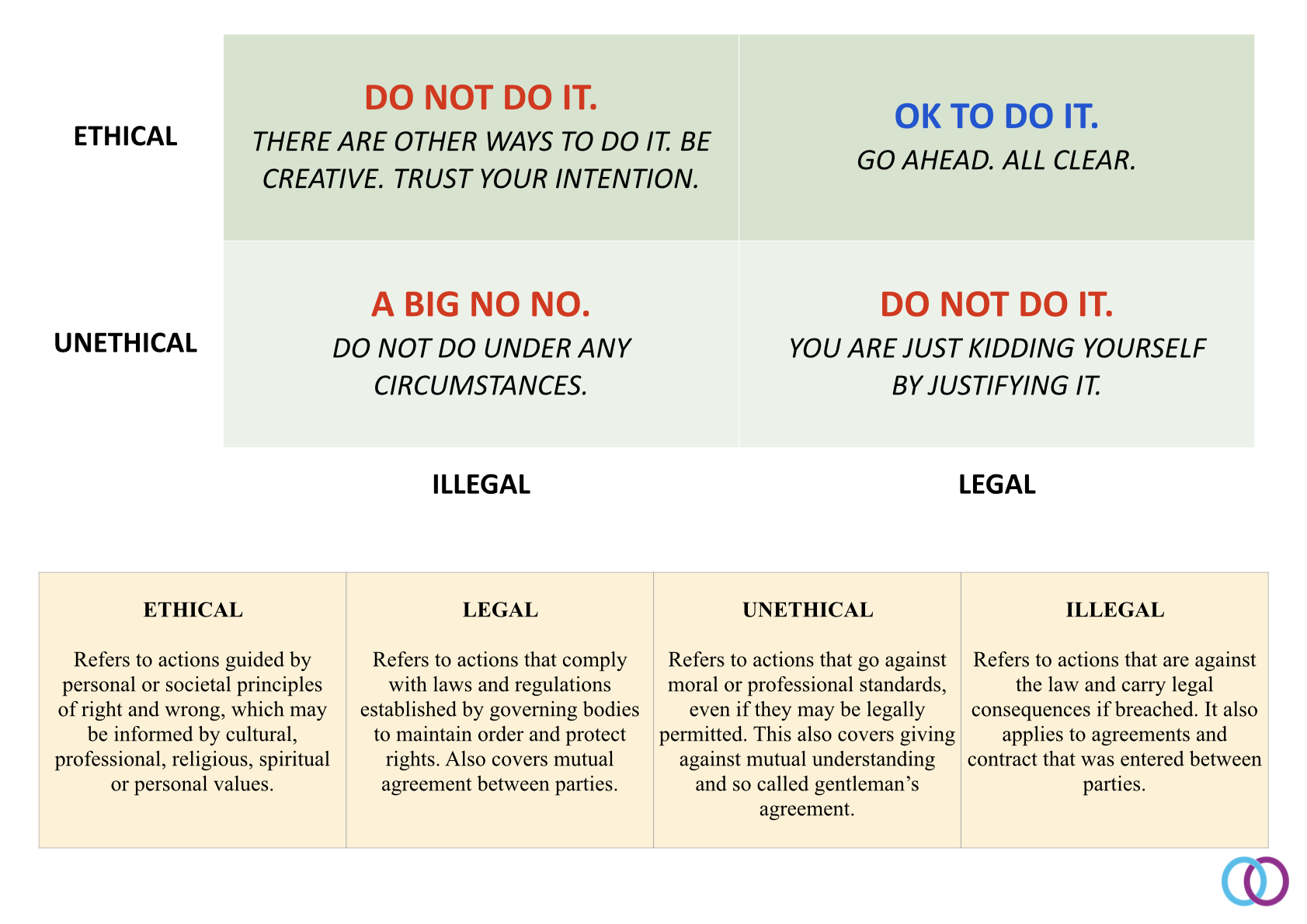
Ethical: Refers to actions guided by personal or societal principles of right and wrong, which may be informed by cultural, professional, religious, spiritual or personal values. For example:Honesty, fairness, and responsibility often fall under ethical principles in professional settings.
Legal: Refers to actions that comply with laws and regulations established by governing bodies to maintain order and protect rights. For example: Laws that protect employee rights, such as minimum wage and working hours, define the legal boundaries in the workplace.
Unethical: Refers to actions that go against moral or professional standards, even if they may be legally permitted. For example: Lying about work performance may not be illegal but is often seen as unethical.
Illegal: Refers to actions that are against the law and carry legal consequences if breached. For example: Falsifying documents or committing fraud can lead to severe penalties and legal action.
With these distinction, it is clear that a great decision is one the is ethical and legal. What are some examples of these distinctions coming into play at the workplace.
Four Key Scenarios in Decision-Making
Ethical but Not Legal: Sometimes, doing the right thing may technically be against the rules or laws, putting individuals in complex situations.
Scenario: You work for a company that operates strict confidentiality policies on its customer data. One day, you discover that a customer is at risk of significant harm due to the company’s failure to disclose certain information. Even though sharing this information with the customer would protect them, it would violate company policy and possibly data privacy laws.
Explanation: In this case, acting ethically means prioritizing the customer’s well-being, even if it conflicts with company policy or data regulations. It’s a challenging scenario because legal repercussions might follow, but it highlights the importance of ethical responsibility.
Legal but Not Ethical
There are instances where actions comply with the law but may be morally questionable or even harmful.
Scenario: A company offers an unpaid internship that requires long hours and heavy responsibilities, benefiting from the intern’s hard work without compensation. While unpaid internships are legal in certain contexts, the lack of compensation or support can exploit young professionals trying to gain experience.
Explanation: Legally, the company may be within its rights to offer unpaid internships, but ethically, it raises concerns about fairness and valuing people’s time and effort. For a young professional, this scenario underscores the importance of balancing legality with fair treatment and respect.
Unethical and Illegal
Some actions are clearly wrong, both legally and ethically, and carry serious consequences.
Scenario: A young employee notices their manager asking them to alter financial records to present a better quarterly report. This practice is illegal (financial fraud) and unethical, as it involves dishonesty and potential harm to stakeholders.
Explanation: Engaging in both unethical and illegal actions can severely damage one’s career and lead to legal consequences. This scenario reinforces that adhering to both ethical principles and legal standards is crucial in maintaining professional integrity.
Legal and Ethical
Ideally, professionals should aim for actions that align with both ethical principles and legal requirements, contributing to a healthy workplace culture.
Scenario: An employee witnesses a coworker struggling with a task and offers assistance, following company policies and promoting teamwork. This act supports a positive work environment and adheres to professional conduct codes.
Explanation: By acting both legally and ethically, young professionals build trust, foster collaboration, and contribute positively to their workplace. This scenario serves as a reminder of the benefits of aligning personal values with company standards.
With this as a guideline or framework, decision making now seems less daunting. However, it is still not easy. Hopefully, it will be easier now with a framework to guide us.
 akar setempat, akal sejagat