Why Great Trainers Think Long Before They Ever Begin Speaking

–
An Empty Room
There is a moment before every workshop that I have always loved.
The room is empty.
The chairs have been arranged. Flip charts stand quietly in the corners. Markers have been tested. Learning materials wait patiently on the tables. The graphic framing is already on the wall, ready to capture the learning journey.
Everything is ready.
Yet nothing has begun.
Or has it?
To most people, it is simply an empty training room.
To me, it is where learning begins.
Not when participants walk through the door. Not when the trainer says, “Good morning. Not even when the first activity starts.
By then, learning has already begun.
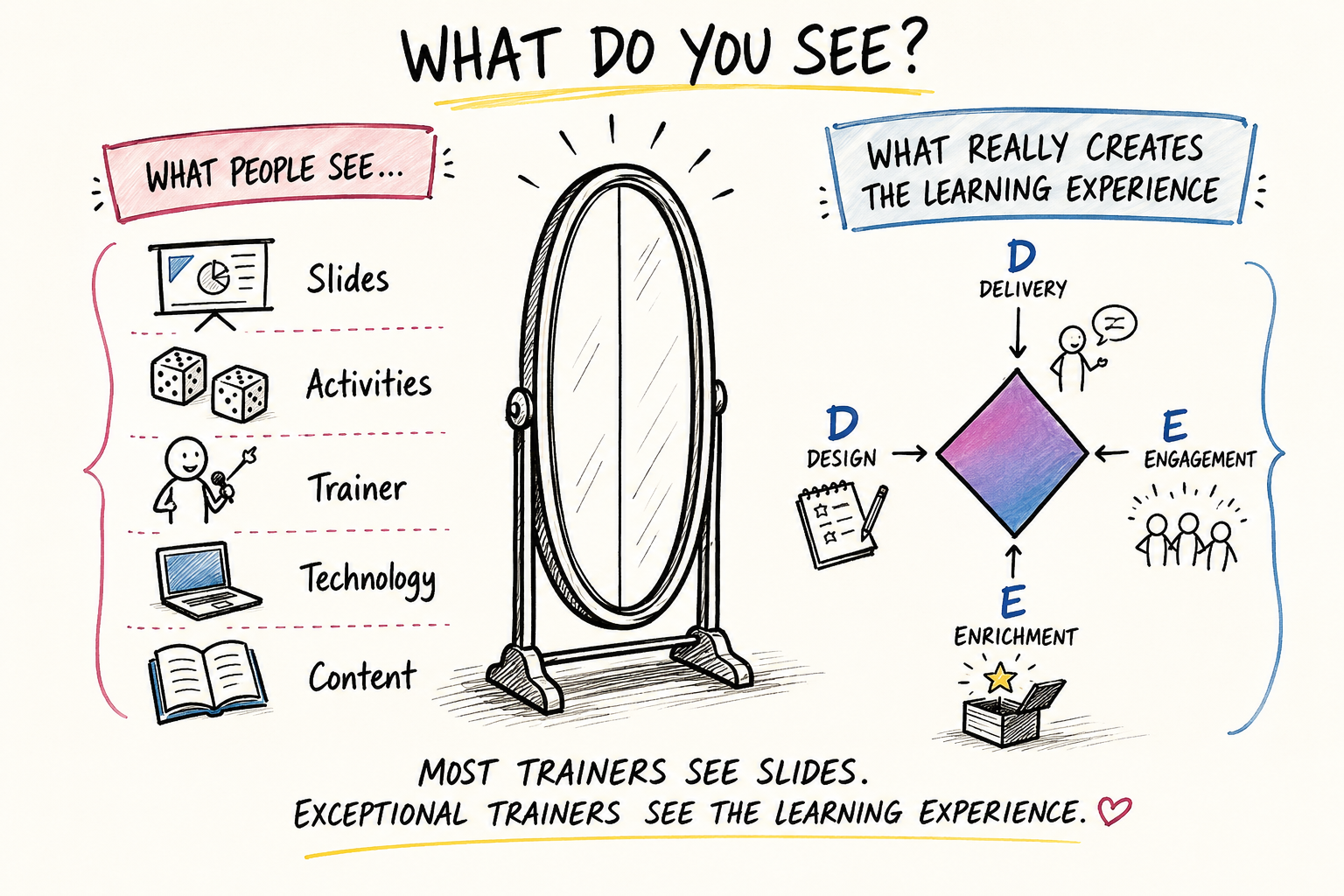
Someone has imagined the journey. Someone has anticipated the questions. Someone has thought about the conversations. Someone has decided what participants should experience before deciding what they should know. Someone has quietly designed learning.
That someone is what I call a trainer-designer—someone who understands that long before learning becomes visible, it has already been thoughtfully designed.
Ironically, I did not discover this by becoming a trainer.
I discovered it by preparing training rooms.
Long before I ever stood in front of participants, I spent almost three years working part-time as a Training Assistant.
Can you believe it?
Some people collect stamps as a hobby.
I collected training programmes.
Whenever a programme was running, I would happily take leave from my full-time job just to be there. I loved being part of an environment where people were learning and growing. Even if my role was small, I knew I was contributing to something that could positively change another person’s life.
My work was simple.
Prepare the room. Arrange the tables. Put up the posters. Check the jumbo markers. Position the flip charts. Prepare refreshments. Look after the trainers. Pack everything away.
Sometimes… even clean the toilets.
None of it sounded impressive.
Yet today, I consider those years to be one of the greatest educations of my professional life.
Looking back, I realise I wasn’t merely supporting training.
I was quietly observing how learning itself was being prepared.
–
Three Index Cards
One particular incident has stayed with me ever since.
At that time, I was leading a team of Training Assistants. Before every programme, the lead trainer would brief us on the logistics for the day.
One instruction immediately caught my attention.
Every Training Assistant had to carry three index cards—exactly three inches by four inches—and one black pen in their pocket before the programme began.
It sounded strangely specific.
I remember wondering whether it really mattered.
Surely any piece of paper would do.
Surely any pen would work.
For a brief moment, I was tempted to simplify the instruction.
Fortunately, something inside me whispered, “Don’t.”
So I followed the instructions exactly as they were given.
Thank goodness I did.
During the briefing, the trainer checked every one of us.
Only after confirming that everyone had the correct materials did he explain why.
Each card had a different purpose.
Each size had been chosen deliberately.
Even the black ink mattered because the cards would later be displayed, grouped and discussed as part of the learning process.
Suddenly, everything made sense.
What had seemed like an unnecessary logistical detail was, in fact, an intentional design decision.
That day, without realising it, I witnessed one of the most important lessons of my career.
Great training is rarely accidental.
The smallest details often exist for the biggest reasons.
At the time, however, I didn’t yet have the language to explain what I had witnessed.
I simply assumed,
“That’s how experienced trainers work.”
Only years later did I realise…
I hadn’t merely been observing experienced trainers.
I had been observing experienced learning designers.
I just didn’t know it yet
–
The Room That Changed Everything
Only years later did I realise…
I hadn’t merely been observing experienced trainers.
I had been observing experienced learning designers.
I just didn’t know it yet.
That realisation came when I walked into a room that would quietly change the way I saw training forever.
It was sometime in 2003.
I had just joined the design team for the Character Building Module of Malaysia’s National Service Training Programme. Ironically, I entered the project because of publishing.
I stayed because I fell in love with learning.
I still remember arriving at the Ascot serviced apartments in the heart of Kuala Lumpur.
During the development phase of the programme, the design team stayed there, and one of the apartments had been transformed into what I can only describe as a learning design studio.
The moment I stepped inside, I knew I had entered a world completely different from anything I had seen before.
Post-it notes covered almost every wall.
In the centre of the room hung a massive planning chart stretching across one side. At that time, I had no idea what I was looking at. Today, I know it was the architecture of an entire learning journey.
Each day of the programme had its own learning objective.
Around every objective were clusters of Post-it notes.
Activities. Reflections. Debriefs. Discussions. Questions.
Everything had a place. Everything had a purpose.
Around the chart stood experienced designers from Canada, the United Kingdom, the United States, Hong Kong, Singapore and Malaysia.
They weren’t presenting. They were debating.
I remember quietly standing near the doorway, not wanting to interrupt. To be honest, I didn’t understand half of what they were discussing. Much of the terminology was completely new to me.
But I couldn’t stop watching.
One designer would move a Post-it note.
Another would move it back.
Someone suggested replacing an activity.
Someone else questioned the sequence.
Then the questions began.
- “What experience do we want the learners to have before this discussion?”
- “What reflection should come afterwards?”
- “What question should the facilitator ask?”
- “Will this activity produce the learning we want?”
The more I listened, the more one thing became clear.
Nobody was arguing about activities.
They were arguing about learning.
The activity wasn’t the hero.
The learner was.
Every decision revolved around a single question: “How will this help people learn?”
That question stayed with me long after I left the apartment.
At that time, I couldn’t fully explain why.
Years later, I realised that this simple question had quietly become the foundation of my own philosophy of learning.
Until then, I had always assumed that great trainers were great because they knew how to stand confidently in front of a room.
That day, I discovered something very different.
Great trainers spend far more time thinking about learning than thinking about themselves.
That observation has never left me.
Those design sessions taught me that learning design is rarely about inspiration.
It is about observation. It is about asking better questions. It is about refining. It is about moving one Post-it note… and then moving it back again.
Because every small decision shapes the learner’s experience.
Again. And again. And again.
Looking back today, I realise I wasn’t simply watching a design meeting.
Without knowing it, I was witnessing the foundations of the philosophy that would shape the rest of my career.
That day, I walked into the apartment believing that great trainers were people who spoke well.
I walked out beginning to understand that great trainers first learn to think deeply about learning.
Everything else comes afterwards.
–
From Observation to Application
The lessons I learnt in those design sessions did not remain on the walls of the Ascot apartment.
Soon, I would have the opportunity to put them into practice.
A few years later, I was given the responsibility of designing my own learning programmes. One of my earliest opportunities came through a project with Nestlé Malaysia.
Until then, most of my experience had been in Experiential Learning (ExL). I was comfortable designing activities that allowed participants to learn through experience and reflection. But this project introduced me to something that would expand the way I thought about learning even further—Accelerated Learning (AL).
Accelerated Learning gave me more than a collection of techniques.
It gave me a design methodology.
Instead of asking, “What activity should I run?” I found myself asking a very different question: “What learning experience do I want participants to have?”
That simple shift changed everything.
Rather than building programmes around content, I began designing them around the learner’s journey.
Every activity had a purpose. Every discussion had an intention. Every reflection had a destination.
The programme was no longer a series of sessions.
It became a carefully designed learning experience.
For the first time, I wasn’t simply facilitating someone else’s design.
I was creating my own.
Looking back, I realise that what gave me confidence wasn’t creativity alone.
It was having a design process.
When you understand how people learn, designing no longer feels like guesswork.
It becomes a series of thoughtful decisions.
That confidence stayed with me.
Over the years, I designed programmes for organisations across different industries, audiences and challenges. Some programmes evolved. Others were redesigned. Many were adapted to changing needs and contexts.
But one principle never changed.
Impact by Design, Not by Chance.
Every programme began with the learner.
Not the slides. Not the activities. Not even the trainer.
The learner.
–
The Invisible Work Behind Great Learning

Today, when people compliment a workshop, they often notice the delivery.
They remember the stories. They enjoy the activities. They talk about the energy in the room.
What they rarely see are the hundreds of decisions that quietly made those moments possible.
They don’t see the questions asked before the programme was written.
They don’t see the ideas that were discarded because they served the trainer more than the learner.
They don’t see the activities that were redesigned, refined, tested and redesigned again.
And that’s exactly how it should be.
Good learning design is almost invisible.
When it is done well, participants remember the learning—not the design itself.
Even today, whenever I arrive early for a workshop, I still enjoy standing alone in the room before anyone else arrives.
The chairs are ready. The materials are in place. The walls are waiting.
To most people, it is still just an empty room. To me, it is the beginning of a learning journey.
Because I now know something I didn’t know when I was a young Training Assistant carrying three index cards in my pocket.
Great trainers are not remembered because they speak well.
They are remembered because they think deeply about learning long before they ever begin speaking.
That is why I believe…
Great learning doesn’t happen by chance. It happens by design.