Tag: training

  • Design: Where Great Learning Begins

    Why Great Trainers Think Long Before They Ever Begin Speaking

    An Empty Room

    There is a moment before every workshop that I have always loved.

    The room is empty.

    The chairs have been arranged. Flip charts stand quietly in the corners. Markers have been tested. Learning materials wait patiently on the tables. The graphic framing is already on the wall, ready to capture the learning journey.

    Everything is ready.

    Yet nothing has begun.

    Or has it?

    To most people, it is simply an empty training room.

    To me, it is where learning begins.

    Not when participants walk through the door. Not when the trainer says, “Good morning. Not even when the first activity starts.

    By then, learning has already begun.

    Someone has imagined the journey. Someone has anticipated the questions. Someone has thought about the conversations. Someone has decided what participants should experience before deciding what they should know. Someone has quietly designed learning.

    That someone is what I call a trainer-designer—someone who understands that long before learning becomes visible, it has already been thoughtfully designed.

    Ironically, I did not discover this by becoming a trainer.

    I discovered it by preparing training rooms.

    Long before I ever stood in front of participants, I spent almost three years working part-time as a Training Assistant.

    Can you believe it?

    Some people collect stamps as a hobby.

    I collected training programmes.

    Whenever a programme was running, I would happily take leave from my full-time job just to be there. I loved being part of an environment where people were learning and growing. Even if my role was small, I knew I was contributing to something that could positively change another person’s life.

    My work was simple.

    Prepare the room. Arrange the tables. Put up the posters. Check the jumbo markers. Position the flip charts. Prepare refreshments. Look after the trainers. Pack everything away.

    Sometimes… even clean the toilets.

    None of it sounded impressive.

    Yet today, I consider those years to be one of the greatest educations of my professional life.

    Looking back, I realise I wasn’t merely supporting training.

    I was quietly observing how learning itself was being prepared.

    Three Index Cards

    One particular incident has stayed with me ever since.

    At that time, I was leading a team of Training Assistants. Before every programme, the lead trainer would brief us on the logistics for the day.

    One instruction immediately caught my attention.

    Every Training Assistant had to carry three index cards—exactly three inches by four inches—and one black pen in their pocket before the programme began.

    It sounded strangely specific.

    I remember wondering whether it really mattered.

    Surely any piece of paper would do.

    Surely any pen would work.

    For a brief moment, I was tempted to simplify the instruction.

    Fortunately, something inside me whispered, “Don’t.”

    So I followed the instructions exactly as they were given.

    Thank goodness I did.

    During the briefing, the trainer checked every one of us.

    Only after confirming that everyone had the correct materials did he explain why.

    Each card had a different purpose.

    Each size had been chosen deliberately.

    Even the black ink mattered because the cards would later be displayed, grouped and discussed as part of the learning process.

    Suddenly, everything made sense.

    What had seemed like an unnecessary logistical detail was, in fact, an intentional design decision.

    That day, without realising it, I witnessed one of the most important lessons of my career.

    Great training is rarely accidental.

    The smallest details often exist for the biggest reasons.

    At the time, however, I didn’t yet have the language to explain what I had witnessed.

    I simply assumed,

    “That’s how experienced trainers work.”

    Only years later did I realise…

    I hadn’t merely been observing experienced trainers.

    I had been observing experienced learning designers.

    I just didn’t know it yet

    The Room That Changed Everything

    Only years later did I realise…

    I hadn’t merely been observing experienced trainers.

    I had been observing experienced learning designers.

    I just didn’t know it yet.

    That realisation came when I walked into a room that would quietly change the way I saw training forever.

    It was sometime in 2003.

    I had just joined the design team for the Character Building Module of Malaysia’s National Service Training Programme. Ironically, I entered the project because of publishing.

    I stayed because I fell in love with learning.

    I still remember arriving at the Ascot serviced apartments in the heart of Kuala Lumpur.

    During the development phase of the programme, the design team stayed there, and one of the apartments had been transformed into what I can only describe as a learning design studio.

    The moment I stepped inside, I knew I had entered a world completely different from anything I had seen before.

    Post-it notes covered almost every wall.

    In the centre of the room hung a massive planning chart stretching across one side. At that time, I had no idea what I was looking at. Today, I know it was the architecture of an entire learning journey.

    Each day of the programme had its own learning objective.

    Around every objective were clusters of Post-it notes.

    Activities. Reflections. Debriefs. Discussions. Questions.

    Everything had a place. Everything had a purpose.

    Around the chart stood experienced designers from Canada, the United Kingdom, the United States, Hong Kong, Singapore and Malaysia.

    They weren’t presenting. They were debating.

    I remember quietly standing near the doorway, not wanting to interrupt. To be honest, I didn’t understand half of what they were discussing. Much of the terminology was completely new to me.

    But I couldn’t stop watching.

    One designer would move a Post-it note.

    Another would move it back.

    Someone suggested replacing an activity.

    Someone else questioned the sequence.

    Then the questions began.

    • “What experience do we want the learners to have before this discussion?”
    • “What reflection should come afterwards?”
    • “What question should the facilitator ask?”
    • “Will this activity produce the learning we want?”

    The more I listened, the more one thing became clear.

    Nobody was arguing about activities.

    They were arguing about learning.

    The activity wasn’t the hero.

    The learner was.

    Every decision revolved around a single question: “How will this help people learn?”

    That question stayed with me long after I left the apartment.

    At that time, I couldn’t fully explain why.

    Years later, I realised that this simple question had quietly become the foundation of my own philosophy of learning.

    Until then, I had always assumed that great trainers were great because they knew how to stand confidently in front of a room.

    That day, I discovered something very different.

    Great trainers spend far more time thinking about learning than thinking about themselves.

    That observation has never left me.

    Those design sessions taught me that learning design is rarely about inspiration.

    It is about observation. It is about asking better questions. It is about refining. It is about moving one Post-it note… and then moving it back again.

    Because every small decision shapes the learner’s experience.

    Again. And again. And again.

    Looking back today, I realise I wasn’t simply watching a design meeting.

    Without knowing it, I was witnessing the foundations of the philosophy that would shape the rest of my career.

    That day, I walked into the apartment believing that great trainers were people who spoke well.

    I walked out beginning to understand that great trainers first learn to think deeply about learning.

    Everything else comes afterwards.

    From Observation to Application

    The lessons I learnt in those design sessions did not remain on the walls of the Ascot apartment.

    Soon, I would have the opportunity to put them into practice.

    A few years later, I was given the responsibility of designing my own learning programmes. One of my earliest opportunities came through a project with Nestlé Malaysia.

    Until then, most of my experience had been in Experiential Learning (ExL). I was comfortable designing activities that allowed participants to learn through experience and reflection. But this project introduced me to something that would expand the way I thought about learning even further—Accelerated Learning (AL).

    Accelerated Learning gave me more than a collection of techniques.

    It gave me a design methodology.

    Instead of asking, “What activity should I run?” I found myself asking a very different question: “What learning experience do I want participants to have?”

    That simple shift changed everything.

    Rather than building programmes around content, I began designing them around the learner’s journey.

    Every activity had a purpose. Every discussion had an intention. Every reflection had a destination.

    The programme was no longer a series of sessions.

    It became a carefully designed learning experience.

    For the first time, I wasn’t simply facilitating someone else’s design.

    I was creating my own.

    Looking back, I realise that what gave me confidence wasn’t creativity alone.

    It was having a design process.

    When you understand how people learn, designing no longer feels like guesswork.

    It becomes a series of thoughtful decisions.

    That confidence stayed with me.

    Over the years, I designed programmes for organisations across different industries, audiences and challenges. Some programmes evolved. Others were redesigned. Many were adapted to changing needs and contexts.

    But one principle never changed.

    Impact by Design, Not by Chance.

    Every programme began with the learner.

    Not the slides. Not the activities. Not even the trainer.

    The learner.

    The Invisible Work Behind Great Learning

    Today, when people compliment a workshop, they often notice the delivery.

    They remember the stories. They enjoy the activities. They talk about the energy in the room.

    What they rarely see are the hundreds of decisions that quietly made those moments possible.

    They don’t see the questions asked before the programme was written.

    They don’t see the ideas that were discarded because they served the trainer more than the learner.

    They don’t see the activities that were redesigned, refined, tested and redesigned again.

    And that’s exactly how it should be.

    Good learning design is almost invisible.

    When it is done well, participants remember the learning—not the design itself.

    Even today, whenever I arrive early for a workshop, I still enjoy standing alone in the room before anyone else arrives.

    The chairs are ready. The materials are in place. The walls are waiting.

    To most people, it is still just an empty room. To me, it is the beginning of a learning journey.

    Because I now know something I didn’t know when I was a young Training Assistant carrying three index cards in my pocket.

    Great trainers are not remembered because they speak well.

    They are remembered because they think deeply about learning long before they ever begin speaking.

    That is why I believe…

    Great learning doesn’t happen by chance. It happens by design.
  •  The DDEE Framework: An Introduction

     The DDEE Framework: An Introduction

    A simple framework for understanding what distinguishes competent trainers from exceptional ones. 

      Opening Observation

    People often ask me what it takes to become a great trainer.

    Sometimes the question comes from someone who has just completed a Train-the-Trainer programme. Other times it comes from an experienced learning facilitator who has spent years in the profession and yet still feels there is another level they have not quite reached.

    Regardless of who asks, my response is usually the same.

    “That depends on what you mean by a great trainer.”

    It is an important distinction because our profession often celebrates what is easiest to see.

    We admire polished slides, energetic presenters, engaging activities, humorous speeches, entertaining moments and confident facilitators. We attend workshops to learn new techniques, new icebreakers and new technologies, hoping each new tool will make us a better trainer.

    Those things certainly have their place.

    But over the years, I have become convinced that they are not what truly distinguishes exceptional trainers.

    That conviction did not come from reading another book. It came from watching trainers… thousands of them.

    The Question

    One observation stayed with me throughout my career.

    Why could two trainers facilitate exactly the same programme and yet produce completely different learning experiences?

    The same facilitator guide + The same slides + The same activities.

    Sometimes even the same type of participants.

    Yet one workshop ended with polite applause. The other ended with participants saying,

    “That changed the way I think.”

    The difference intrigued me.

    If everything else was identical… What made one trainer unforgettable or exceptional?

    The Story

    My own journey into Learning and Development began more than two decades ago through Malaysia’s National Service Programme.

    Ironically, I did not begin as a trainer.

    I began as a training assistant.

    My responsibilities revolved around logistics, learning materials and supporting trainers. At the time, I thought I was simply helping programmes run smoothly.

    I now realise I was receiving an education that no classroom could have provided.

    Day after day, I observed trainers from different backgrounds, personalities and levels of experience.

    Some commanded attention effortlessly. Some connected deeply with participants. Some struggled despite possessing impressive credentials.

    As the years passed, I became a table facilitator, then a trainer, a learning designer and eventually a Trainer of Trainers. Later, I coached learning facilitators across industries, organisations and cultures.

    Looking back, I realise I have probably learned as much from observing trainers as I have from facilitating learning myself.

    Patterns began to emerge. And once I saw them… I couldn’t unsee them.

    The Discovery

    The trainers I admired most were rarely the ones with the longest résumés.

    Nor were they always the most charismatic speakers.

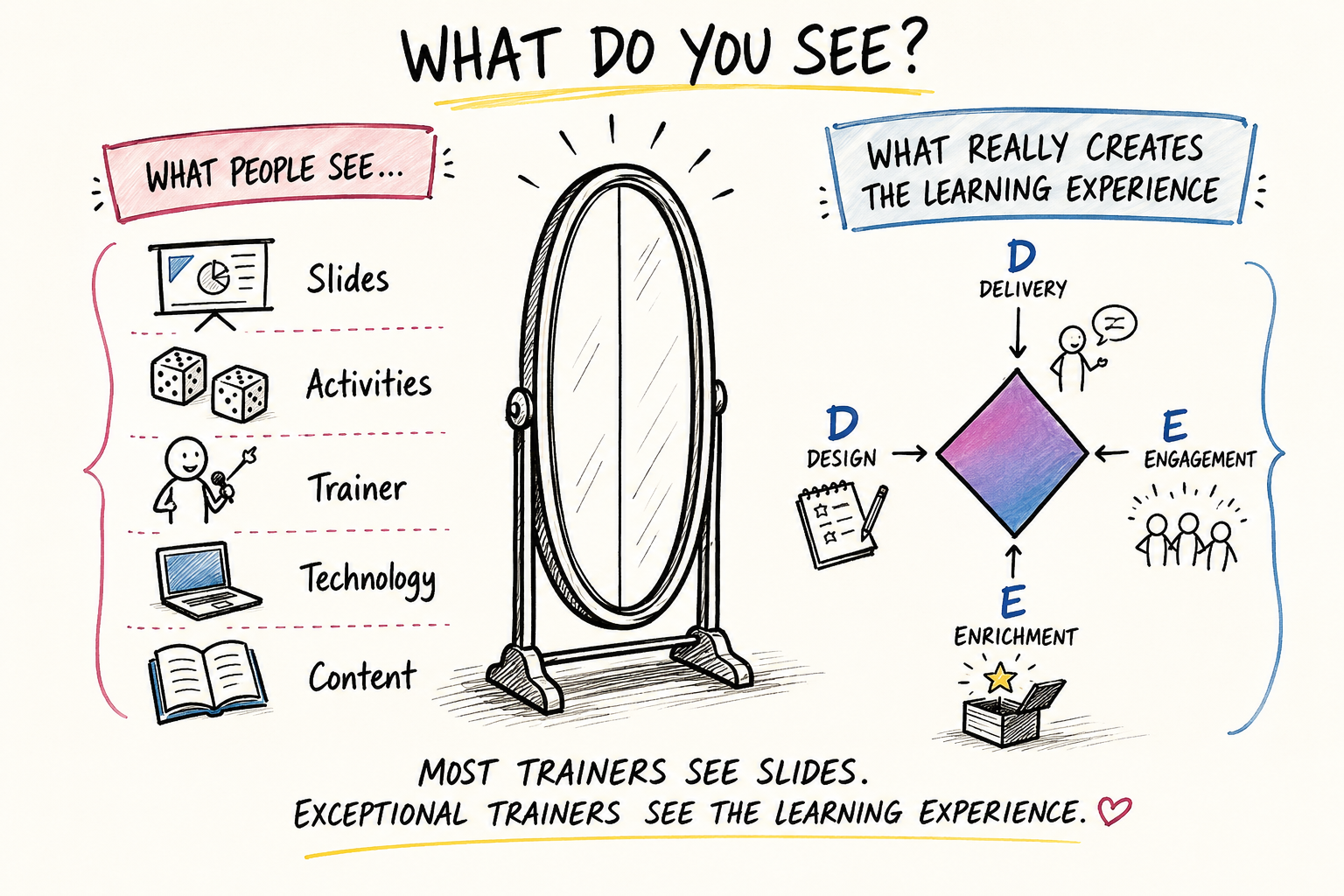
    Instead, they consistently demonstrated excellence in four interconnected dimensions, which are:

    • They designed learning intentionally.
    • They delivered with clarity and confidence.
    • They engaged participants as active contributors.
    • And they enriched every learning experience with something no lesson plan could ever provide… Themselves… Their stories… Their professional judgement… Their curiosity… Their failures… Their wisdom… Their humanity.

    That observation eventually evolved into what I now call the DDEE Framework.

    Not because I wanted another model. But because I wanted a simple way to explain what I had been witnessing for years.

     The DDEE Framework

    The DDEE Framework proposes that exceptional trainers develop mastery across four complementary dimensions which are:

    • Design – Design is where learning begins. Long before participants enter the room, thoughtful trainers have already considered outcomes, learning journeys, activities, timing and opportunities for reflection. Design gives learning its structure and purpose.
    • Deliver – Delivery is how ideas come alive. It is not simply about speaking well. It is about communicating with clarity, adapting to the moment and helping learners make sense of complex ideas. Delivery gives learning its voice.
    • Engage – People rarely remember what they merely hear. They remember what they experience. Engagement transforms learners from passive listeners into active participants who question, contribute, experiment and reflect together. Engagement gives learning its energy.
    • Enrich – Enrichment is the dimension that fascinates me most. It is also the dimension that can never be copied. Enrichment is the intersection between your expertise and your humanity. It is where your professional experiences, personal stories, hard-earned lessons, observations and wisdom become part of the learning itself. 

    Every trainer can download slides. Every trainer can attend another certification. Every trainer can learn another facilitation technique. But no trainer can replicate your personal journey as a practitioner.

    In many ways, enrichment is where credibility becomes visible.

    Over the years, I have come to believe that a trainer’s ability to enrich learning is deeply influenced by six sources of credibility—a framework I call the 6P Model.

    That, however, is a conversation for another mentoring essay. For now, it is enough to recognise this: “Enrichment is not something you acquire overnight. It is something you cultivate over a lifetime”.

    A Simple Metaphor

    The DDEE Framework reminds me of baking a cake.

    A memorable cake is never created by a single ingredient but via a set of ingredients that naturally fused together.

    Flour alone is not enough.

    Neither are eggs.

    Nor butter.

    Nor sugar.

    Each ingredient serves a unique purpose, and only when they work together does something truly memorable emerge.

    Training is no different.

    Design provides the structure.

    Delivery gives it life.

    Engagement creates interaction.

    Enrichment gives it character.

    Remove any one ingredient, and something essential is missing.

    Master all four, and learning becomes something people carry with them long after the workshop ends.

    Practical Application

    The next time you prepare for a workshop, don’t begin with your slides.

    Begin with these four questions, which are:

    • How intentionally have I designed this learning experience?
    • How clearly will I deliver it?
    • How meaningfully will participants engage with it?
    • How will I enrich it with something that only I can bring?

    Those four questions may shape your growth more than learning another activity or downloading another template.

    Remember This…

    Exceptional trainers are not built through content alone.

    They are shaped through intentional design, thoughtful delivery, meaningful engagement and lifelong enrichment.

    The DDEE Framework is not a checklist.

    It is a way of thinking.

    A reminder that excellence is rarely the result of mastering one competency.

    It is the integration of many.

    Like the ingredients of a memorable cake, each dimension contributes something unique.

    Together, they create experiences that inform minds, inspire action and leave lasting impressions.

    Mentor’s Reflection

    Think about the last programme you facilitated.

    Which dimension came most naturally to you?

    Which one received the least attention?

    More importantly…

    Which dimension will you intentionally strengthen before your next workshop?

    Conversation Starter

    Imagine two trainers.

    • The same programme.
    • The same facilitator guide.
    • The same slides.
    • The same activities.
    • The same participants.

    Would they create the same learning experience?

    If your answer is NO, what do you believe makes the difference?

    I’d love to hear your perspective.

    Until Our Next Mentoring Conversation…

    Every trainer has access to content.

    Every trainer can improve their delivery.

    Every trainer can learn how to engage.

    But the trainers who leave a lasting legacy are those who continually enrich every learning experience with the one thing no one else possesses… Themselves.

    Because the goal of training is never simply to transfer knowledge.

    It is to develop an effective mindset, knowledge and skills, and transform them into meaningful actions that create positive impact—for others and for themselves.

    When learning changes the way we think, the way we act and the impact we create, it does something even more profound…. It changes who we become.

    Until our next mentoring conversation…

    Keep observing.
    Keep reflecting.
    Keep learning.
    Most importantly… keep becoming.

    Until our next mentoring conversation,

    -r juara baharuddin
    L&D Practitioner | Graphic Facilitator | Coach | Learning Experience Designer | Learning Game Designer |

  • What Actually Makes a Great Trainer?

    People often ask me what makes a great trainer.

    It is a question I have been trying to answer for more than twenty years.

    Not because I did not have an answer, but because my answer kept evolving as I grew in the profession.

    My journey in Learning and Development (L&D) did not begin as a trainer.

    It began as a training assistant.

    Between 2000 and 2003, my responsibilities were largely behind the scenes—supporting programmes, preparing materials, assisting facilitators and ensuring everything ran smoothly. I was close enough to observe training, but not yet responsible for leading it. 

    Then came 2003.

    The Malaysian National Service Programme (NS) was launched, and I was given what I now consider my first major opportunity in L&D. I became involved in the Character Building Module (CB) —not as a trainer, but as part of the team responsible for localising the programme for Malaysia.

    My role was to translate and publish the participant workbooks and facilitator manuals while working closely with a team of experienced foreign trainers. This was ideal for me because I was a publisher at that time and a training junkie to add. In essence I was involved in designing the training.

    It sounds straightforward. It wasn’t.

    The programme was being designed while we were simultaneously translating, editing and publishing it. Every day brought new revisions, new activities, new terminology and new learning experiences. It was one of the most intense professional periods of my early career.

    My official entry into L&D was quite unique because most trainers enter into the industry by delivering trainings. Not me. I entered through design.

    Looking back, I realise something important.

    I was unknowingly receiving one of the best mentoring experiences anyone could hope for.

    To localise the content properly, I could not simply translate words. I had to understand the learning philosophy behind them. I observed the trainers deliver sessions. I experienced the activities myself. I sat through and assisted in Train-the-Trainer (TTT) programmes. I watched how they asked questions, facilitated discussions, handled difficult participants and conducted debriefs. During the breaks and outside training hours I continued my informal learning as an apprentice. The lunch conversations, the late night debriefing sessions, those breakfast groundings I use to absorb as much as I can from my mentors. I realise that the most profound learning happened during those unofficial training times.

    In many ways, I was learning long before anyone called me a trainer.

    Then, in 2004, everything changed.

    The Government decided that future NS trainers should be trained by Malaysians rather than relying on foreign facilitators.

    Someone looked at me and said, “You know the programme. You were involved in the development of it. You can train.”

    Of course, knowing the content and training others are two very different things.

    But before I fully appreciated the difference, I said yes.

    That single decision changed the trajectory of my career.

    To train other trainers, I quickly realised that understanding the content was not enough. I had to become competent in delivering it myself.

    So I began delivering.

    By then, I had accumulated several distinct competencies, although I did not think of them that way at the time.

    I had learned logistics from being a training assistant.

    I had learned how to support learning as a table facilitator.

    I had learned instructional design through localisation and publication of training content.

    I was now learning delivery as a trainer.

    All of this happened the old-fashioned way.

    Through mentors. Through apprenticeship.

    The foreign trainers who had come to Malaysia were remarkably generous. They did not simply teach us what to do. They explained why they did it. They shared stories, corrected our mistakes, challenged our assumptions and slowly transferred years of professional experience that no manual could ever capture.

    That experience shaped my view of learning forever.

    The methodology used in the CB was heavily influenced by Accelerated Learning (AL), itself drawing from the work of Bobbi DePorter and the SuperCamp movement. Experiential Learning (ExL) was not simply a theory we discussed. It was how we learned.

    One principle stood out above all others.

    Learning should be facilitative.

    That is one reason I have always preferred calling myself a facilitative trainer rather than simply a trainer.

    Training, to me, has never been about talking. It has never been about teaching.

    It has always been about helping people learn.

    As I immersed myself in AL, I developed another capability—facilitating learning itself.

    This included asking meaningful questions, listening deeply, processing participant reflections, conducting debriefs, building rapport and creating conversations that helped learners construct their own understanding.

    Years later, when I reflected on everything I had learned, I began asking myself a simple question.

    What actually makes a great trainer?

    That question eventually led me to my first model.

    I called it DDE: Design  |  Deliver  |  Engage.

    The logic was straightforward.

    Every trainer needs content.

    But content alone is not training.

    Content must first be intentionally designed into a meaningful learning experience.

    This is where learning methodologies matter.

    Whether it is ExL, AL, Game-Based Learning (GBL), Project-Based Learning (PBL) or another approach, the trainer must understand how people learn before deciding what to teach. That is Design.

    Once the learning experience has been designed, someone has to bring it to life. That is Delivery.

    Delivery draws upon another body of knowledge and skills—public speaking, storytelling, improvisation, presentation techniques and communication.

    Finally, even the best-designed and best-delivered session can fail if learners remain passive.

    The trainer must engage people.

    This is where facilitation, coaching, active listening, rapport building, questioning and debriefing become essential.

    Together, these three components formed what I believed to be the foundation of effective training.

    Design  |  Deliver  |  Engage

    For many years, I was satisfied with that model.

    Until one day, I wasn’t.

    Imagine two trainers; Trainer A and Trainer B.

    Both are certified. Both use exactly the same content. Both understand ExL. Both are excellent presenters. Both know how to facilitate discussions.

    If their Design, Delivery and Engagement are equally strong…

    Why do participants still leave saying, “I want to attend Trainer A’s workshop again”?

    That question bothered me.

    The answer eventually came from observing participants rather than trainers.

    People no longer attend workshops because information is scarce. Information is everywhere.

    Books provide knowledge. The internet provides examples. Artificial intelligence can explain concepts in seconds. The trainer is no longer the custodian of knowledge.

    Nor do people attend workshops merely to be entertained. If entertainment is all they seek, there are countless better options.

    Neither do they attend simply to interact with strangers.

    So why do they come?

    The answer, at least for me, is this.

    People come to be enriched.

    They come for wisdom.

    They come for perspective.

    They come for stories that cannot be found in textbooks.

    They come for lessons learned through failure.

    They come for practical applications.

    They come for examples that have been tested in the real world.

    They come for someone who has walked the path before them.

    That realisation fundamentally changed my model.

    DDE became DDEE.

    Design. Deliver. Engage. Enrich.

    The two Ds represent what we do with the content.

    The two Es represent what we do for the learner.

    Design shapes the learning.

    Delivery communicates it.

    Engagement involves the learner.

    Enrichment gives the experience meaning.

    It also explains something I had observed for years without being able to articulate it.

    Two trainers may possess identical Design, Delivery and Engagement skills.

    They will never possess identical Enrichment.

    Enrichment is deeply personal.

    It is built through years of practice, countless workshops, difficult conversations, mistakes, successes, reflection and continuous learning.

    It is also why I place such importance on the first “P” in my 6P Model of Credibility—Practitioner.

    People value trainers who have lived the work. The trainer walk the talk.

    Qualifications matter.

    Professionalism matters.

    Good programme design matters.

    But lived experience gives every trainer a voice that no one else can replicate.

    Perhaps that is why mentoring has become increasingly important to me.

    There are countless Train-the-Trainer programmes out there.

    Most do an excellent job of developing the Delivery skill of a trainer, some develop the Design skill and a few develop a trainer’s Engagement skills.

    Even far fewer intentionally develop Enrichment.

    Not because they don’t want to.

    Because enrichment cannot simply be taught.

    It is accumulated.

    Shared.

    Questioned.

    Observed.

    Reflected upon.

    Mentored.

    After twenty-three years in this profession, I no longer believe that the greatest value a trainer brings is content.

    Content is everywhere. Content is not King. Content is merely the starting point.

    The greatest value we bring is ourselves—our experience, our judgement, our stories, our failures, our lessons and our willingness to share them generously with others.

    Perhaps that is what people have been looking for all along.

    Not just another trainer.

    But someone who can genuinely enrich their journey.